Fly from the surface of Earth to the edge of the Milky Way without a loading screen. 2.5 million real stars, every known exoplanet, thousands of real galaxies and nebulae, spacecraft maps of the planets and moons, and billions of procedural worlds in between, rendered physically in HDR.
One continuous, physically based simulation from metres to megaparsecs.
Hierarchical coordinates keep millimetre precision anywhere in a galaxy 100,000 light-years across.
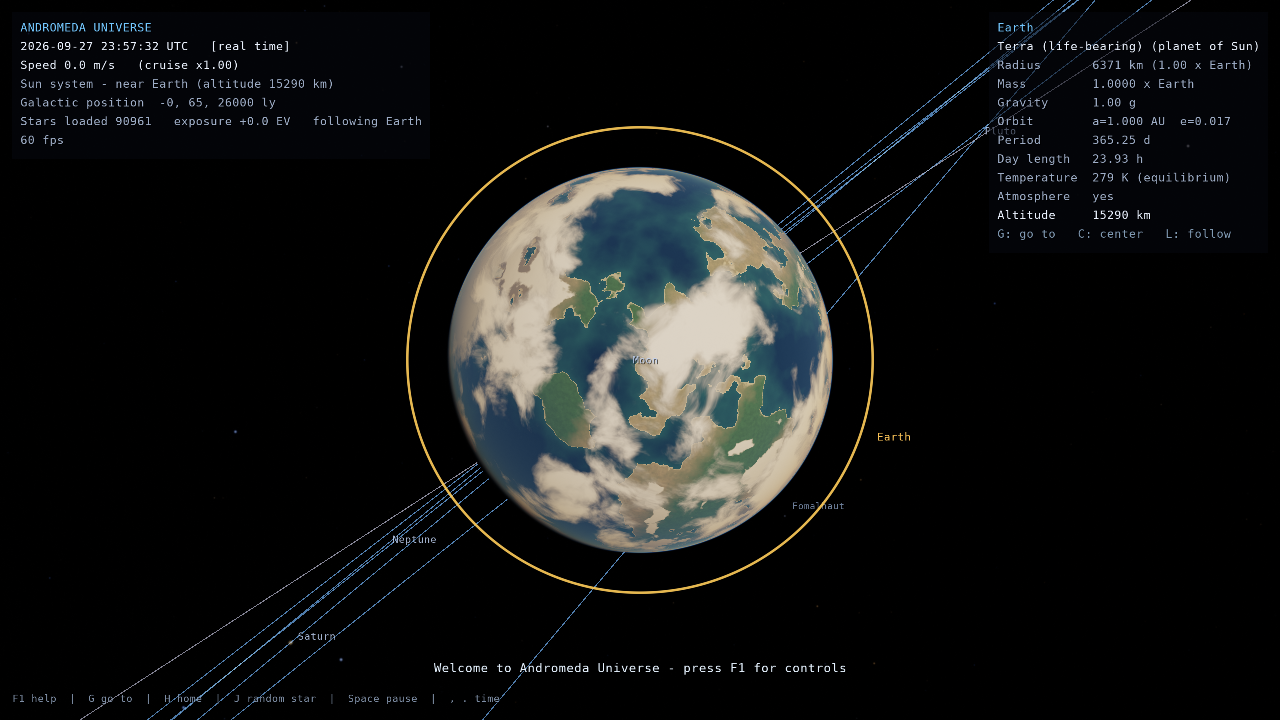
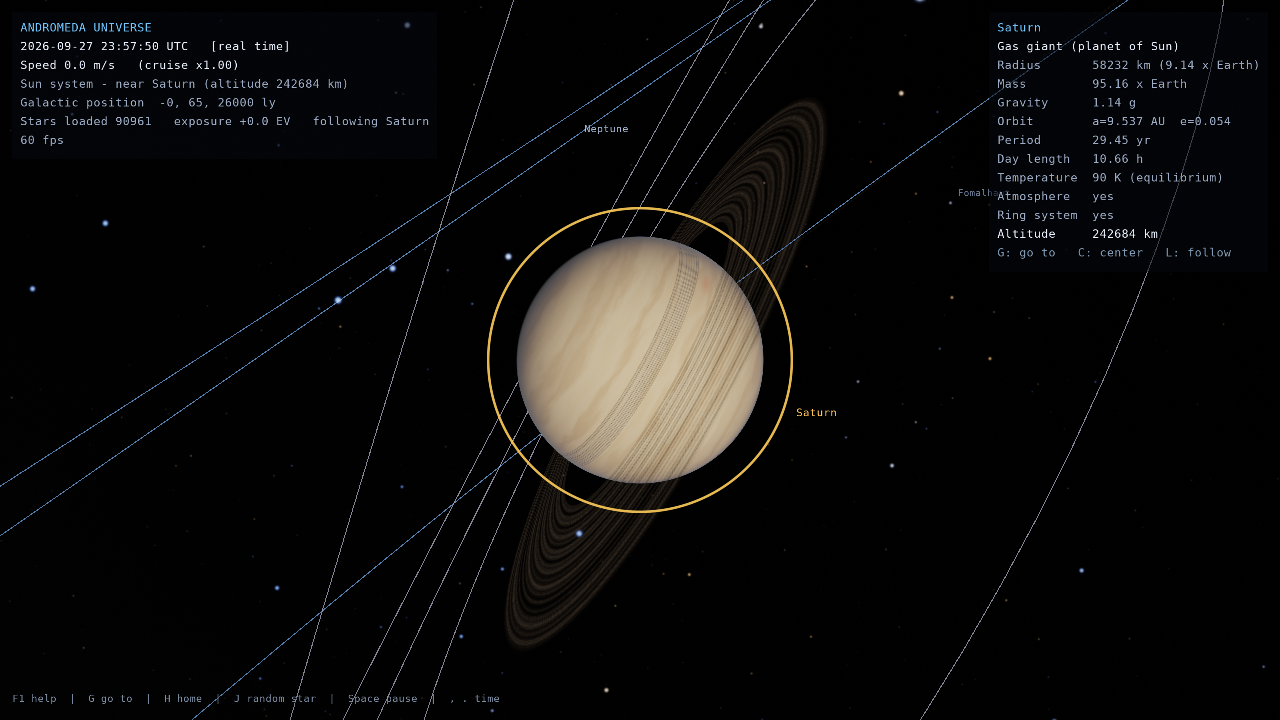
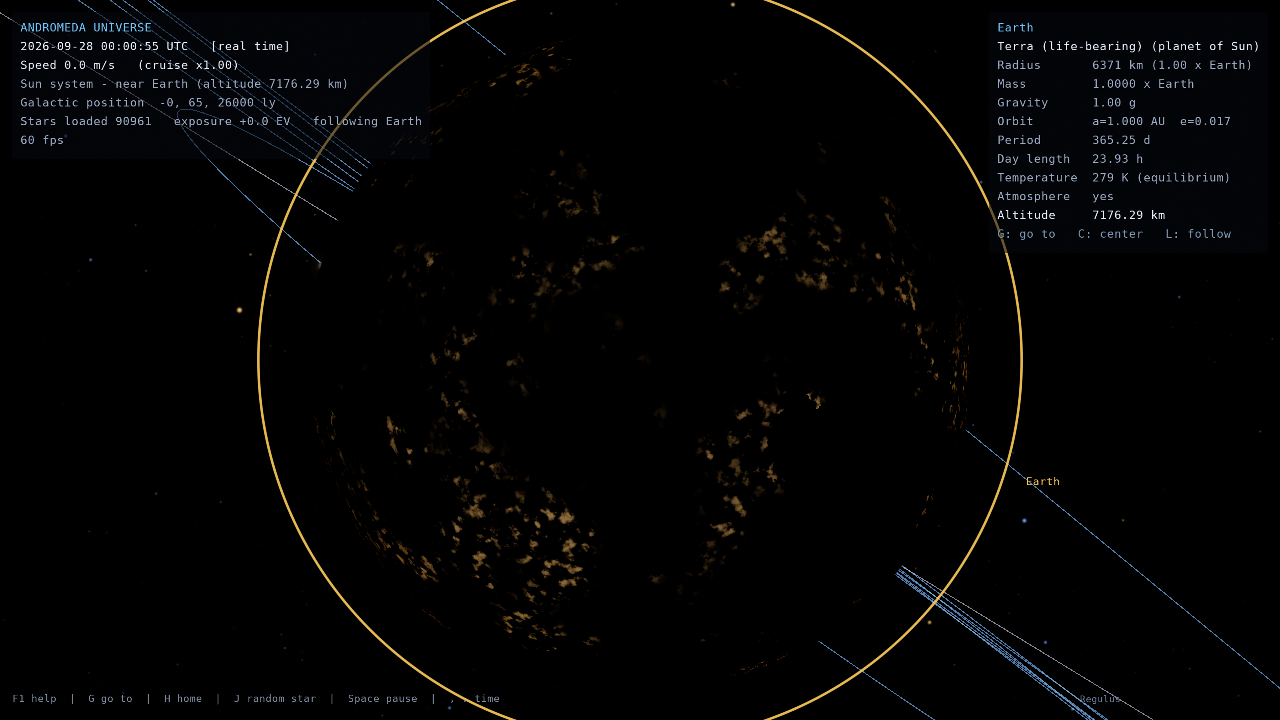
Spacecraft maps of every planet and the major moons (up to 8K), real clouds and city lights on Earth, JPL orbits and the Moon's real position, running live from today's date: eclipses happen when they really do.
Hipparcos, Tycho-2 and Gaia DR3 distances (AT-HYG): the night sky from Earth is the real one, down to magnitude 11. Every star is a place you can fly to.
Over 5,000 confirmed planets around 3,700 real stars, with their measured orbits and sizes. Transiting planets really cross their star as seen from Earth.
About 9,400 galaxies, nebulae and star clusters from OpenNGC at their real distances and orientations: Andromeda, the Orion Nebula, the Virgo Cluster, the Ring Nebula and more.
Ray-traced Schwarzschild lensing, a photon ring, and accretion disks with Doppler beaming. Visit Sagittarius A*, Cygnus X-1 and more.
Terrain, oceans with sun glint, clouds and their shadows, Rayleigh and Mie atmospheres, rings, city lights and eclipses.
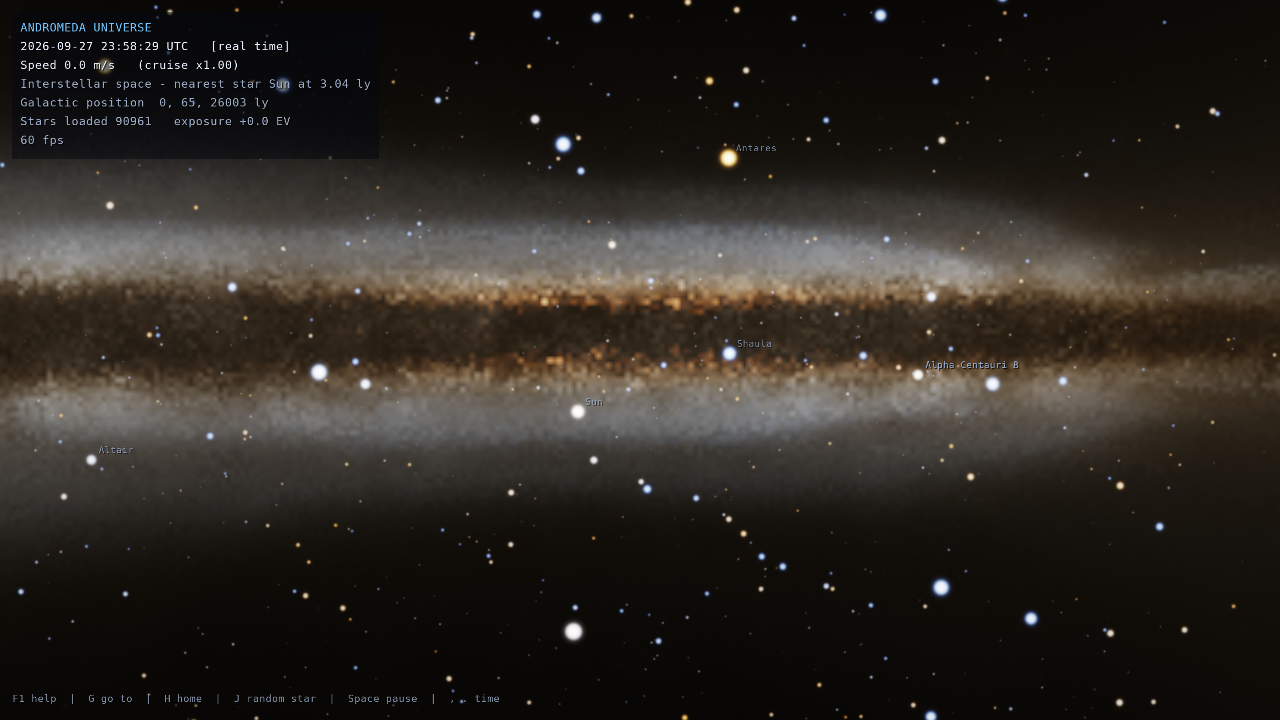
A volumetric Milky Way with dust lanes and spiral arms. Beyond the reach of the catalogues, procedural stars fill in the faint population, drawn from the real stellar mass distribution.
Change the universe seed for a whole new galaxy. Bookmarks, search, screenshots, and about 40 graphics and control settings.
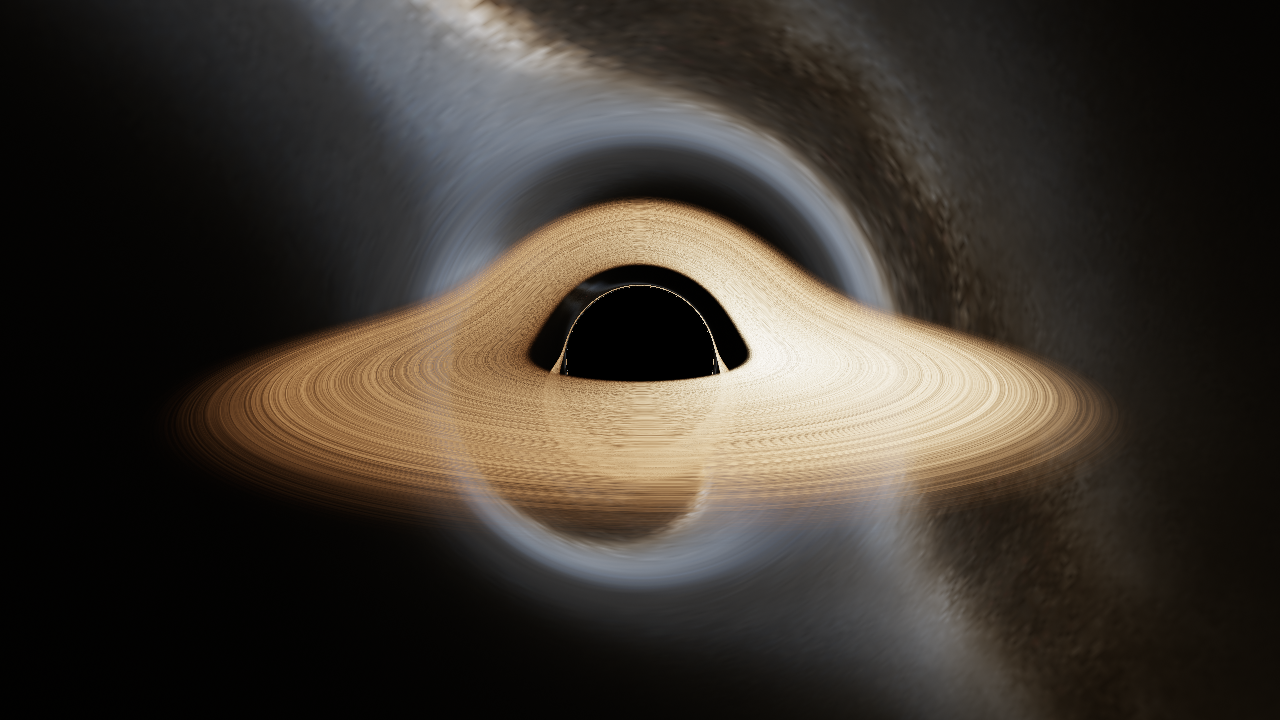
Captured with the engine's own renderer.
Try everything first. Keep exploring for free afterwards.
A 64-bit PC with a graphics card that supports Vulkan or DirectX 12 and current drivers. On Linux you need a Vulkan driver (Mesa or NVIDIA); X11 and Wayland both work.
Windows: extract the zip and run andromeda-universe.exe. SmartScreen may ask on first launch: choose "More info → Run anyway". Linux: extract the archive and run ./andromeda-universe. Keep the data folder next to the program: it holds the star catalogue and planet maps.
Stars: AT-HYG v3.2 (Hipparcos, Tycho-2, Gaia DR3; CC BY-SA 4.0). Exoplanets: Open Exoplanet Catalogue (MIT). Galaxies and nebulae: OpenNGC (CC BY-SA 4.0). Planet and moon maps: Solar System Scope (CC BY 4.0, from NASA data), NASA/JPL/USGS and LPI mosaics. Full credits are in data/CREDITS.txt. Galaxy and nebula shapes are drawn procedurally from their catalogued type, size and orientation.
At startup the app checks this site for a new version. If there is one, it offers to install it (or does so automatically if you turn that on). You can also check under Esc → Updates.
If you buy from inside the app (Esc → License → Buy), it activates itself as soon as the payment is done. Otherwise copy the key from the thank-you page or your e-mail and use Esc → License → Paste license key. The key is activated online once (on up to 3 computers) and re-checked when the app starts; it keeps working for 30 days without internet. Lost your key? Recover it here.
Checkout is handled by Stripe: cards, Apple Pay, Google Pay and other local methods. A one-time purchase, no subscription. It includes one year of updates, and the app keeps working forever with the versions you have.
You keep the free Explorer edition: the Solar System and every star within 100 light-years, with updates. A license unlocks the rest of the galaxy.